
In 2025, Chipper Cash's data transformations grew to around 900 dbt models powering compliance, fraud detection, and growth systems for over seven million customers across nine African countries. Some of the pipelines that depend on these models run every three minutes. They need dbt output to be fresh, correct, and reliable.
For four years, dbt Cloud orchestrated our transformations. Then a one-line configuration change broke our most critical pipeline silently. This is the story of what went wrong, how we fixed it, and why we ultimately replaced dbt Cloud with a self-hosted solution.
Two runtimes, one time bomb
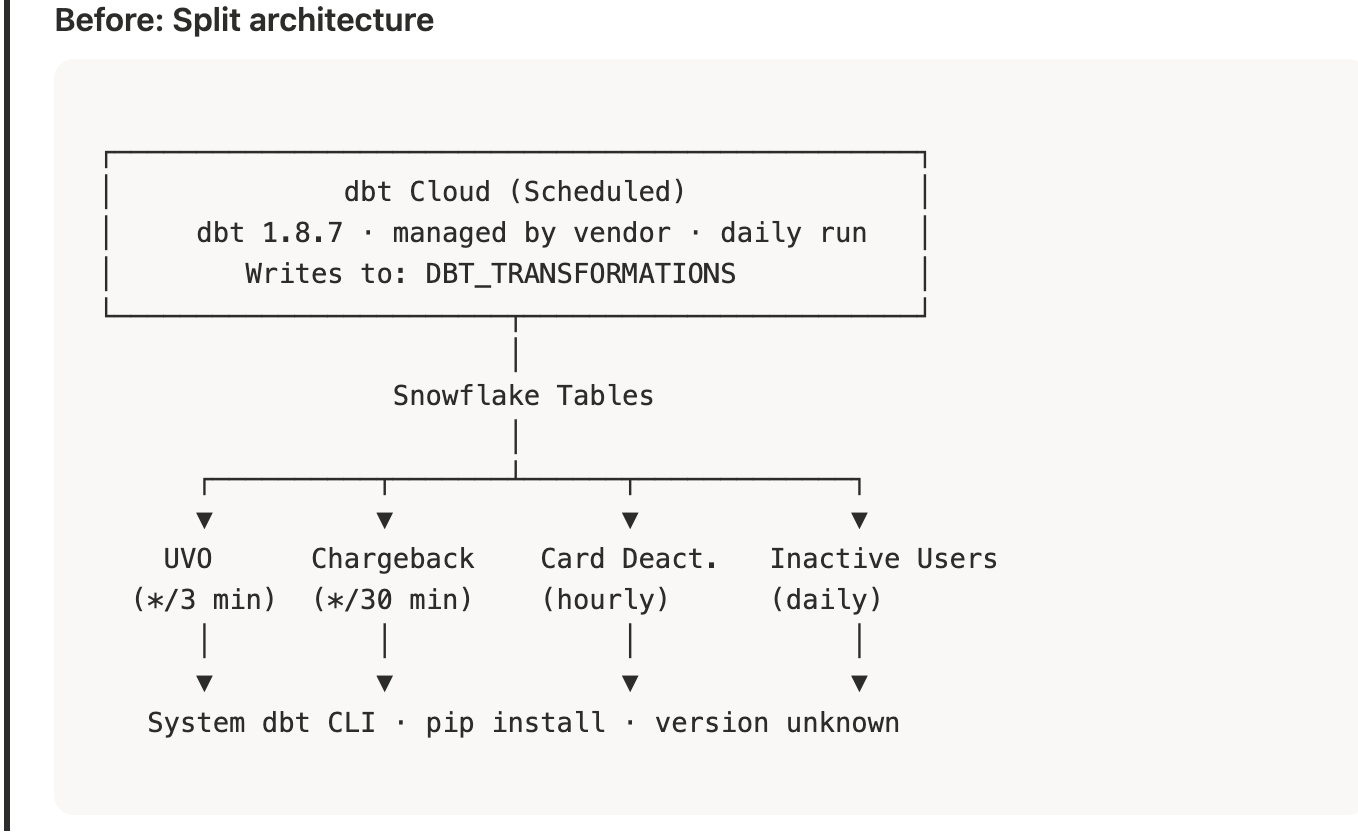
dbt Cloud owned the daily scheduled refresh of all models, running dbt 1.8.7 and writing to our product. DBT_TRANSFORMATIONSschema in Snowflake. But several pipelines like user verification, chargeback processing, card deactivation also invoke dbt as a pre-step before executing their own business logic. These pipelines called the dbt CLI binary directly, relying on whatever version happened to be pip-installed on our GCP VM.
We had two runtimes with no version coordination. Any change to dbt_project.yml that relied on newer dbt syntax would work in dbt Cloud but break on the VM, or vice versa.
The incident
We updated dbt_project.yml to use the data_tests configuration key, introduced in dbt 1.8 as a replacement for the deprecated tests key. dbt Cloud, running 1.8.7, handled it without issue. The system-installed dbt on our GCP VM was older. It rejected the configuration:
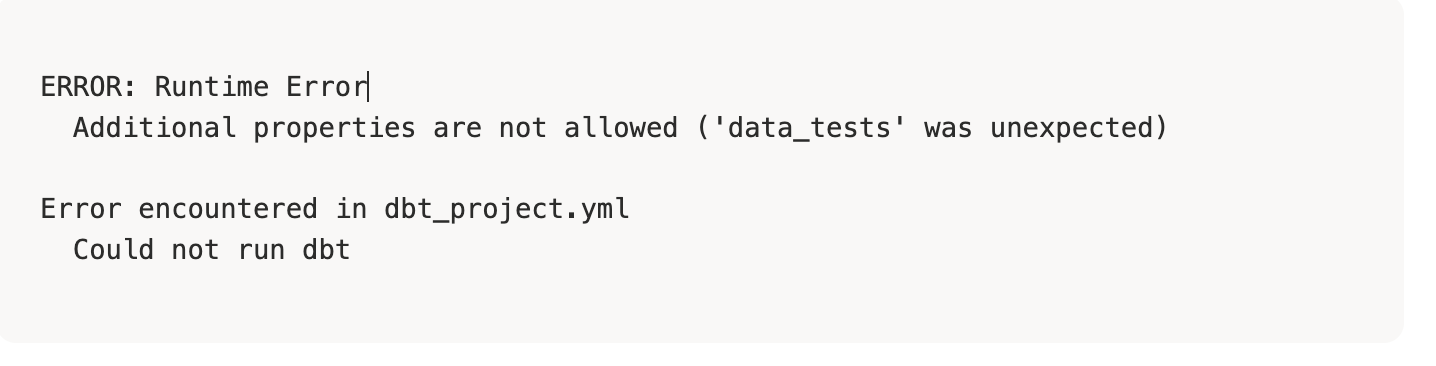
Our User Verification Oracle (UVO) pipeline assigns KYC tiers to every user on the platform. It runs every three minutes via cron. Its shell script executed dbt run, received this error, and then moved on to the next step as though nothing had happened. The script lacked set -e which would have halted execution on any non-zero exit code. Without it, the dbt failure was invisible. The UVO engine continued running, processing stale data from the last successful dbt refresh.
Because of this bug, users were not receiving tier updates. Cronitor, which tracked the pipeline's overall exit code, saw a success because the final bazel run step, the UVO engine itself, completed without error. It had no way to know that the data it operated on was days old.
We discovered the problem when a team member noticed that tier assignments had stopped changing.
How we built the replacement
Our codebase uses Bazel to manage Python dependencies hermetically. We already had a thin Python wrapper around dbt's CLI (dbt.invoker) that invokes dbt programmatically and raises exceptions on failure:

Bazel locks the dbt-core and dbt-snowflake versions in the build graph, packaging them alongside the dbt project files (dbt_project.yml, profiles.yml, model SQL). Every invocation then whether from the daily scheduler, a pipeline pre-step, or a CI job will use the exact same dbt binary built from the same dependency tree.
The migration had three components.
1. Hermetic pipeline scripts
Every shell script that previously called the system dbt CLI was updated to invoke dbt through Bazel. We also added set -e to ensure dbt failures halt the pipeline immediately.

The --profiles-dir . flag is no longer necessary as dbt.invoker handles the working directory internally. If any step fails, set -e stops execution and returns a non-zero exit code. Cronitor sees the failure and alerts the team.
2. Self-hosted dbt scheduler
We built a Python pipeline (dbt_scheduler) that runs daily at midnight UTC via cron. It determines the run mode, incremental on most days, full refresh on the first of each month, and invokes dbt through the same Bazel-managed invoker, parses the run results JSON, persists per-model execution history to a Snowflake audit table (dbt_run_history), and posts a Slack summary with success and failure counts.
CLI was updated to invoke dbt through Bazel. We also added set -e to ensure dbt failures halt the pipeline immediately.

The --profiles-dir . flag is no longer necessary as dbt.invoker handles the working directory internally. If any step fails, set -e stops execution and returns a non-zero exit code. Cronitor sees the failure and alerts the team.
2. Self-hosted dbt scheduler
We built a Python pipeline (dbt_scheduler) that runs daily at midnight UTC via cron. It determines the run mode, incremental on most days, full refresh on the first of each month, and invokes dbt through the same Bazel-managed invoker, parses the run results JSON, persists per-model execution history to a Snowflake audit table (dbt_run_history), and posts a Slack summary with success and failure counts.

If any model fails, the scheduler raises an exception with the list of failed models, and posts an error alert to Slack with stakeholder mentions, and exits with a non-zero code for Cronitor.
3. Ad hoc runs via GitHub Actions
The most-used feature of dbt Cloud was the ability to trigger one-off jobs like a full refresh after merging a PR that changes a cost formula, for instance. We replaced this with a GitHub Actions workflow supporting two trigger modes.
Manual trigger from the GitHub Actions UI. Engineers select the model, target environment, and whether to run a full refresh.
PR comment trigger. Engineers comment on any pull request:

The workflow checks out the PR branch, runs dbt via Bazel against Snowflake, and posts the result back on the PR as a comment and to Slack. This allows engineers can validate dbt model changes against production data before merging.
Results
We ran the self-hosted scheduler in parallel with dbt Cloud for a week, writing to a test schema. After verifying output parity across all 920 models, we cut over to the self-hosted scheduler targeting the production schema. dbt Cloud jobs were paused as a rollback path for another week before decommissioning.

Lessons learned
Hermetic builds are non-negotiable for data pipelines. When a version mismatch can cause silent data staleness in a compliance-critical system, "it works on dbt Cloud" is not a sufficient guarantee. Every execution path needs the same managed version, and that version needs to be tracked in source control.
Silent failures are the most expensive kind. The incident wasn't caused by a complex bug. It was a one-line config change and a missing set -e. What made it costly was that nothing stopped the pipeline from proceeding with stale data. We have since audited every shell script in our pipeline fleet for error handling.
Replace managed services incrementally. Running in parallel before cutting over gave us confidence that no model output had diverged. Keeping dbt Cloud paused rather than deleted gave us a rollback path while we built trust in the new system.
Chipper Cash is building the largest payments network in Africa, serving over seven million customers across nine countries.